|
 |
before
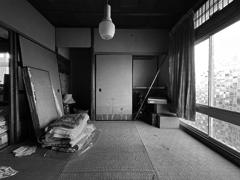
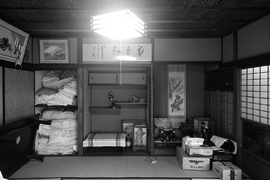
〈邸宅の対角線〉
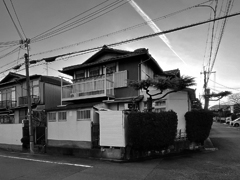
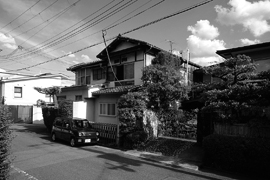
本計画は、まもなく築 100 年を迎える木造住宅のリノベーションである。
対象建物は昭和6年(1931年)に竣工し、昭和2年に認可された土地区画整理事業「洛北第一工区」に
よって形成された宅地とオリジナルの建物である。
今も周辺には当時の邸宅が点在し、本建 物の往年の姿を想起させてくれる。
建築主は70代の夫婦で、ご主人の祖父が購入して以来、三代にわたり受け継がれてきた家である。
計画に先立ち、施主の幼少期の記憶を手がかりに、
これまでの増改築の履歴を丁寧にヒアリング。
部分的に 天井や床を解体して梁組や部材の新旧を確認し、
建物 のオリジナル構成と後年の増築部分を見極めた。
そのうえで、後年に増築された部分を解体し(特に隣家と接して増築されていた部分は丁寧に解体)、
床面積の30%以上を減築。
かつての佇まいを再構築することからプロジェクトを始動した。
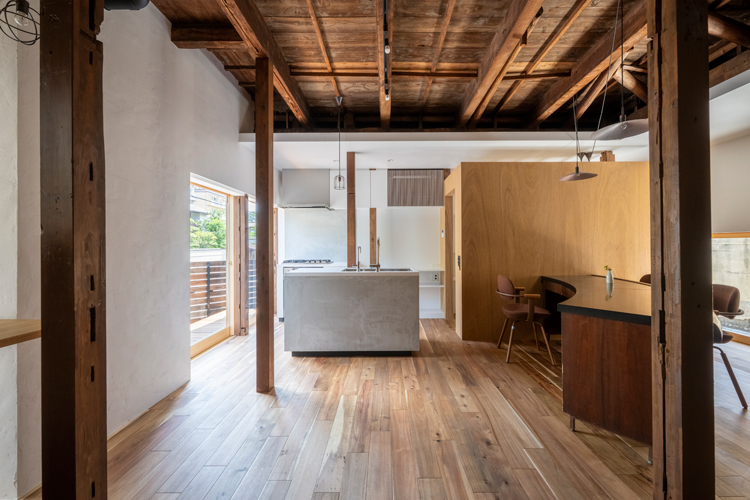
1階はこれから暮らす夫婦ふたりのための快適な生活空間として大きく刷新。
2階は、時折帰省する娘の宿泊や仕事の場として、必要最小限の改修にとどめた。
既存外壁は日本家屋特有の雁行形状であるが、
新しい内部プランをそれに合わせるとガタガタといびつな平面になるため、
斜めの壁で対角線状に空間を二分することで、
古い平面形に新しい生活がアジャストするようにした。
対角に二分した北西側に寝室や水回りなどのプライベート空間、
南東側にリビング・ダイニングなどのパブリック空間を配し、
回遊性を確保しながら生活領域を緩やかに分節した。
二分する壁は既存梁より低く設け、上部に隙間を設けることで、空間のつながりを保っている。
もとの建物は座敷の二方(あるいは三方)に回り縁 をめぐらせ、
その上部の下屋を桔木によって支える 凝った構造をもっていた。
しかし現代の暮らしでは、その過度に開放的な構えはプライバシーの点からも
構造耐力の点からも好ましくなく、全体としては閉じる計画とした。
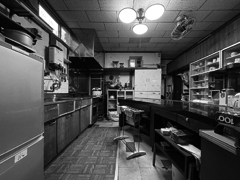
また施主が大切にしてきた大きな ダイニングテーブル(かつて銀行の接客カウンターとして使われていたもの)や、
古い照明器具、建具、ガラス、家具の一部を新しい空間に組み込み、歴史の手触りを継承。
既存建物を単に軸組や外壁ごと残すのではなく、
残す部分、修復・復元する部分、新しくする部分を峻別し、
とりわけ古い要素をできるだけ多く残しながら、
新しいエレメントは古いものを補い、調律する役割を担わせた。
こうして本計画は、施主家族の記憶と地域の歴史を織り込みながら、現代の暮らしに寄り添う新たな住まいへと更新された。
"Diagonal of the old residence"
This project is the renovation of a wooden residence approaching its centennial anniversary.
The house was originally built in 1931,
on a plot developed through the Rakuhoku First District Land Readjustment Project,
an early urban planning scheme in northern Kyoto.
Several houses from that period still remain in the neighborhood,
evoking the refined residential character of the time.
The current owners, a couple in their seventies,
have inherited the house through three generations since it was first purchased by the husband’s grandfather.
Before the design began, the architect conducted extensive interviews with the owners,
tracing the sequence of past extensions through their childhood memories.
Selective removal of ceilings and floors revealed the original timber structure,
allowing a clear distinction between the initial construction and later additions.
The subsequent extensions―especially those that had been built tightly against the neighboring house―
were carefully dismantled, reducing the total floor area by more than 30%.
The renovation began by restoring the house's original form and atmosphere.
The first floor was completely reconfigured for the couple’s present-day life,
while the second floor received only minimal updates,
serving as a guest and work space for their daughter when she visits.
The existing exterior had a stepped, meandering outline typical of traditional Japanese houses.
Rather than following this irregular shape inside,
the new plan introduces a single diagonal wall that divides the house into two zones
―private functions such as the bedroom and bathroom on the northwest side,
and public spaces such as the living and dining area on the southeast.
This diagonal wall maintains spatial flow and connection while softly defining distinct living areas.
It is kept lower than the existing beams,
leaving a continuous gap above to preserve openness and visual unity.
The original house once featured a mawarien
―a surrounding veranda supported by kigumi (bracket-like struts)―
that created an elegant but overly open structure.
In this renovation, such openness was moderated to enhance privacy and structural stability,
giving the house a more enclosed and calm expression.
Several cherished items, including a large dining table once used as a bank counter,
vintage light fixtures, and old fittings and glass, were integrated into the new space,
allowing the tactile memory of the house to continue.
Rather than simply preserving the structure as a relic,
the design carefully distinguished what to keep, repair,
or renew―assigning each new element a role in tuning and complementing the old.
Through this process, the house has been quietly transformed into a home
that weaves together the family’s memory and the history of the neighborhood,
while adapting gracefully to contemporary living.
|